Join us for a frank discussion of obesity and fatness with guest interviewer Zara Alam. Transcript below.
- Fat vs Obese
- Obesity, Health, and Attractiveness
- Shifting Stigma Mindsets
- Looks vs Health
- Education
- Individuality
- Unsolicited Advice and Personal Health
- Fat Isolation and the Acceptance Contradiction
Between 1500 and 1800, scurvy killed more people than shipwrecks, syphilis, and warfare combined. The thing is, a cure was already known. Remedies as simple as oranges and limes was proven to cure scurvy by the British Dr. James Lintz. Despite this, the British Navy continued to use malt ward, a concoction of mashed barley which did next to nothing to help sailors recover, for the next 50 years.
The same motif can be found throughout history. Seat belts were invented long before the automobile but weren’t mandatory in cars until the 1960s. The first confirmed death from asbestos exposure was recorded in 1906, but it wasn’t banned in the U.S. until 1973.
Every discovery in public health, no matter how significant, must compete with traditions, assumptions, and personal beliefs before science becomes practice. That brings us to one of the greatest gaps between science and practice in our modern-day: obesity, a modern epidemic second only to that of drugs and the coronavirus. Let’s break down why that is.
Fat vs Obese
QUINN: Alright, before we begin: I want us to use the words “fat” and “fatness” as opposed to “overweight,” “obese,” or “obesity.” Can we do that?
ZARA: Okay, I can do that. Why?
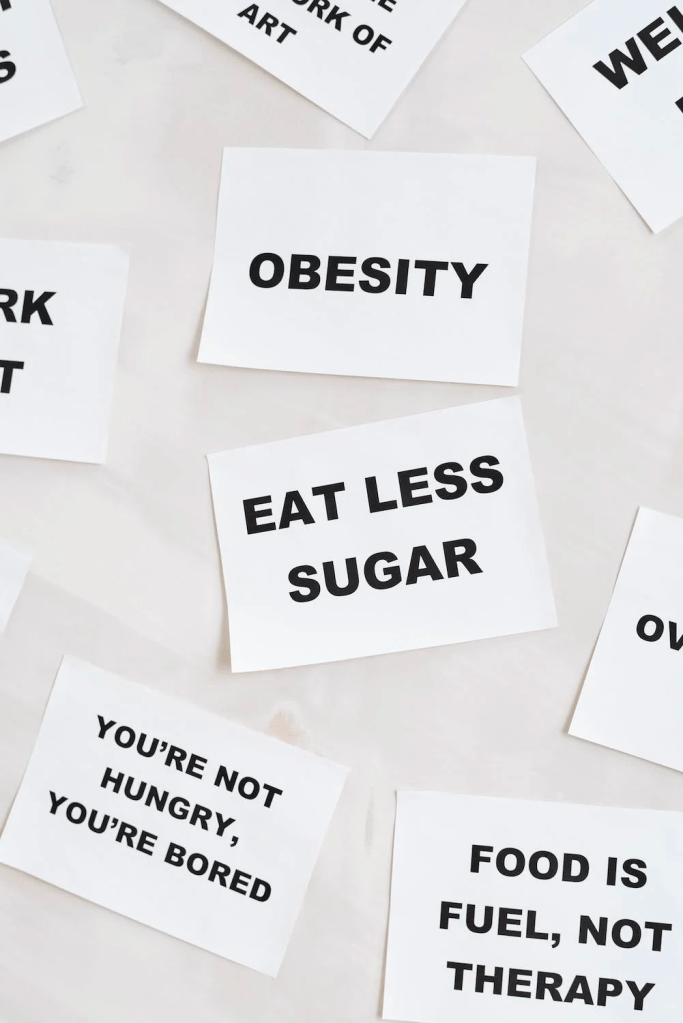
QUINN: So, kind of coming from a fat-studies and fat activist perspective, there’s really a tradition of reclaiming fat as a neutral descriptor of body size, as opposed to a derogatory term that it’s been used as. As opposed to the term “obesity,” which implies kind of a medical frame. This medical frame implies that bodies are pathological and there’s something inherently wrong or abnormal with them. So, there’s no way for us to be not fat-phobic when we use the term “obese,” since its use implies that fat people are a medical problem to be solved rather than just a natural part of human diversity.
ZARA: Okay, so to clarify, when you see someone that you would assume to be overweight, you would use the term “fat” then instead of “obese,” like in your head, for example?
QUINN: Not just to use “fat” as a descriptor, but to use “fat” as a neutral descriptor. We’re not adding connotations to it. There’s denotation, what’s written in the dictionary, and a connotation, what we attach to it. The whole point is to use “fat” as a neutral word, where we don’t attach this connotation, as opposed to using “obesity,” where there’s an inherent connotation, and that is that it’s a medical frame. And most of us don’t have that medical frame, most of us aren’t doctors, so we can’t apply that frame to other people.
And, secondly, because of that medical frame, it already implies that bodies are pathological, that there’s something abnormal with them, as opposed to just embracing them as a natural range of bodies. And so I think those are kind of the two prongs to using fat as opposed to obesity.
Obesity, Health, and Attractiveness
ZARA: OK, that makes sense. I feel like another thing is, though, that a lot of people would say “fatness is unhealthy” or that when someone is fat, they are doing something wrong, like they don’t have a clean diet or they’re not exercising enough. So if you want this to be a neutral term, you’re saying fat is NOT an indication of these things?
QUINN: Yeah, exactly, because when you’re saying fatness is equating to health, you’re again using a medical frame that most of us don’t have. We’re making an assumption, a leap of judgement. And I think what is most interesting about people is they assume that fatness is relating to health, but that’s really not true at all. If you look at fat people, there are ¾ of them, about ¾, who are metabolically healthy. Right? These are people who are classified as obese, in the medical sense of the term, and metabolically healthy. They show no signs of elevated blood pressure, no insulin resistance, and no high cholesterol. And, at the same time, about ¼ of non-overweight people, are what epidemiologists call “the lean unhealthy,” meaning that they do show these signs of elevated blood pressure, insulin resistance, or high cholesterol. So you could say, in some sense, that ¾ of fat people are “healthier” than the ¼ “lean unhealthy” population. Again, though, these three signs are not the end-all-be-all. So I think that the myth that fatness is equating to health is exactly that: a myth, a misnomer.
ZARA: That’s interesting, because I feel like that isn’t addressed a lot. For example, when you look at social media, and you look at people who are larger, fat, even they don’t mention things like this. They more try to “reclaim” the word fat, kind of like you were saying as just a descriptor of how someone appears physically. And just this concept of health being associated with how you look is not necessarily true at all. Especially in this day and age, where people are getting elective surgeries, or trying to look a certain way, or trying to “get with the trend,” especially body trends, which are also constantly changing. I mean right now, I think it was Kim Kardashian got rid of like a lot of her, like, I guess, curviness, and it was kind of like this article came out, and I forget which news article it was, but it was talking about how like the heroine body was in, where it’s like this super, super thin body, as if like you were kind of like a heroin addict, kind of. Like that was the connotation. And so, like, these things are constantly shifting, and this idea of like what is good and what is healthy and what is attractive, even, it’s just I feel like it’s just getting in people’s heads and just misinforming people.
QUINN: Yeah, and I think you bring up a few really good points there. I think the first is that Americans are incredibly visual. And this is not an opinion; this is kind of a fact that’s been established both by sociologists and historians but also by scientists. We rely on visuality a lot. And a lot of this comes with stigma, it comes with connotations attached to it. And we kind of just shoot over there. And I think the second point that you bring up is the idea that healthiness, and attractiveness, and our visual associations with them, are dynamic goals that shift over time. They are not static entities; they constantly move, making them challenging to pin down.
A third thing that you bring up is that these goals are inherently Eurocentric. You touched on that very briefly, but a lot of these goals, when we’re shifting them around, they shift around within the sphere of Eurocentricity. As we know with fat and fatness, a lot of it is very racist. A lot of the way we talk about it is very racist. The history behind things like the BMI, Body Mass Index, which used to be called the Quetelet Index, after Adolf Quetelet who invented it, who was, you know, a very racist person. A lot of these things are inherently tied to race, from fat and fatness to beauty and healthiness. And I say that AND very intentionally, because those are two separate things. Fatness does not equate to attractiveness or healthiness, there’s no, really, corollary between the two, which is something we’re trying to establish as well.
Shifting Stigma Mindsets
ZARA: Right, but then another question I have is that if we are trying to, essentially, completely shift a mindset/viewpoint, how would one go about that? Because we can talk about the issues and misinformation that’s being spread, and what we think we know vs what we know, and what is real. But there is also the fact that we actually need to implement that mindset. Even subconsciously or unconsciously associating fatness with unhealthiness. As I mentioned earlier, a lot of the time, one associates it with diet or lack of exercise. From a societal perspective, if you’re trying to impact so many people, because that is what sets the status quo, how would that be done?
QUINN: Yeah, I think you bring up a couple of points there, the first being how do we impact a great quantity of people? And I think that the first step is education. But even then, as you said, when we’re discounting all these myths, education doesn’t get to the core of it. Sometimes we still have those gut assumptions. And I think that a useful reminder is that what we initially think isn’t always who we are as a person. I think that, for the most part, a great many times, what you think first is not what YOU think, it’s what society has conditioned you to think. What you think second is your own opinion. A lot of times we’re conditioned to feel and think a certain way, and it’s very hard to change that, but what we can change is that second thought, that thought that comes after.
Looks vs Health
ZARA: I think you bring up a very good point. I hadn’t thought of it from that perspective, but I guess initially we are very heavily influenced by society and how we’re socialized, and, with our age, definitely social media. I also think that, to kind of go back to this concept of beauty, I feel as though, at times, the concept of even being healthy is being disregarded for beauty. So long as you’re fitting this beauty standard, and so long as the people that you want to find you attractive are doing so, one might take that as a priority over one’s own health. And then we just shift to this perspective of “OK, this is just what looks the best” and we disregard health.
QUINN: Yeah! And this goes back to that “lean unhealthy” that we were talking about earlier. That ¼ of the normal-weight population who are actually metabolically unhealthy. And, again, we don’t associate them with unhealthiness, because we associate them with “normality” or “attractiveness,” we’re not pathologizing their bodies. And especially skinniness. Statistically, skinniness and fatness are equally abnormal, “abnormal” meaning deviating from the statistical norm, but we don’t associate the abnormalness of being skinny with unhealthiness, we don’t associate it with unnatractiveness, and that’s part of the stigma. But we don’t pathologize their bodies because we view them as something to be attained, some sort of (beauty) goal, kind of like you were talking about with the “heroin body” being a new fad.
Education
ZARA: Obviously, this is a big concern, and a big misinformation campaign, but at the same time when we’re talking about education, in what setting would one be educated? I feel as though this [interview] could be spread across various platforms, but there are so many people telling you different and conflicting things. A lot of people turn towards social media, but at the same time there are so many contradictions that are introduced, so when we mentioned “education” I immediately associated that with formal education. How could that be done, in Physical Education (P.E.), for example? How do we teach people to go after being healthy, instead of chasing goals like “skinny?”
QUINN: I think it’s interesting, because education is both formal and informal, cultural and global. You bring up a very good point, because we have to be very wary of this informal education. The average American consumes 0 peer-reviewed articles a day. A week, even. So I think that it comes down to A) doing your own research, but also B) changing the system. It comes down to the very basics. Even beyond an educational level, at the building level of what we subsidize to eat, agriculturally we subsidize fruits and vegetables the least out of all food products. It starts on that level, on what we see in stores, what is available to buy, and then it comes to education, where it comes to a more meta-level. We need to take a step back. What are we surrounded with? What are we being inculcated with?
That being said, we also have some more stuff to fully educate our [readers], and we’ve talked a bit about how fatness doesn’t equal health, but let’s also talk about how fatness isn’t calories, thinness isn’t diets, and obesity isn’t one condition. I mean, if you look at it, obesity can be a variety of conditions. For example, one person had to treat their obesity after their brain cancer, a tumor, caused them to gain a great amount of weight. Other people are genetically predisposed to obesity. Obesity is not one condition. A lot of people think that obesity is a condition of consuming too many calories, that it’s a simple calculation of calories in and calories out. Calories consumed, and energy expended.
But we know it’s really not that. The Endocrine Society has talked about how growing evidence indicates that obesity pathogenesis (that is, the origin of obesity), involves a process far more complex than the passive accumulation of excess calories. It goes beyond calories. Additionally, thinness is not a diet. ⅔ of people who go on a diet gain back more weight than they lost in the end. Diets have been shown, through peer-reviewed articles, to not help.
These 3 basic facts, that fatness isn’t calories, thinness isn’t diets, and obesity isn’t one condition, are the building blocks of understanding fatness and destigmatizing it.
Individuality
ZARA: An interesting thing to consider as well is that many things are very subjective to who you are individually and how your body works. Just because one thing works for one person, or appears to do so, it might not necessarily translate over to you. And that has been a huge thing, especially on social media. There’s a huge culture of this is the diet that you need, or these are the exercises you need to do, and a lot of the time it simply depends on your personal biology. And sometimes it will work, but many times it won’t.
QUINN: Exactly. Just look at eating disorders. You look at a skinny person with an eating disorder, they have a problem. It’s medically diagnosable, they need help, there’s a pathogenesis, everything. When you look at a fat person who has the same behaviors, who eats the same, who exercises the same, they’re suddenly “doing a good job.” They’re being a “good fat person,” by trying to lose this weight. But they still have an eating disorder, and stigma covers this up. We’re applying standards for average people onto fat people, but when fat people go outside of that normal behavior, and it becomes abnormal behavior, we cover it up anyway, and that, in my opinion, is one of the greatest effects of stigma. It sets that double standard for fat people.
Unsolicited Advice and Personal Health
ZARA: And we know our bodies best, but sometimes we apply our personal knowledge of our own bodies onto other people. And it’s very easy for non-fat people to immediately cast that judgment onto fat people. They also give unsolicited advice.
QUINN: And that’s especially the case with fat people. Even anecdotally, you hear many fat people sharing their stories of how they receive uninvited advice from family, friends, and even strangers. Even medical professionals, and the reason is that it’s required by many insurance companies for a doctor to bring up fat people’s weight management at every visit. And they don’t give good advice, because they don’t spend the time they need to know this person but they offer generic advice anyway.
Fat Isolation and the Acceptance Contradiction
QUINN: I have one final point on stigma and fatness, and that is America hates fat people. This might seem odd for one of the fattest countries in the world, but the reason is because not only do thin people dislike fat people, but fat people also dislike fat people. Fat people grow up in the same, fat-averse culture that everyone else does, and they cannot find solace in each other. Unlike being a minority group, like being gay or black, you cannot claim an identity if the world at large is saying that the identity in question should not exist. Thus, fat people cannot find solace in peer relationships, and as such are incredibly isolated. They feel unwell in one another’s company, as their affinity for one another is dismantled by fat stigma. This has a huge effect on their mental health, and as a result their weight itself. It has been shown that fat people who can find groups with which they can identify and relate freely not only face less stigma, but as a result lose more weight, on average.
ZARA: I agree. It’s an internalized fat-phobia.
QUINN: Exactly.
ZARA: There are also performers like Lizzo, whose brand is based, at least partially, on reclaiming fat identities, and showing that she is beyond just fat: she is healthy and has labels associated with her beyond her fatness. She shows aspects of herself beyond her fatness. There are, of course, other similar people in popular culture, who were “fat” and lose weight, and then are applauded by society. This, of course, breeds its own discourse: some say a person is now beautiful/handsome, and others ask why (s)he is only considered as such once they have lost that weight.
QUINN: We live in a competing culture. There is not just an anti-fat movement vs fat acceptance movement, it’s that within that fat acceptance movement, they are simultaneously saying that they love and accept fat bodies, and yet at the same time the goal for these movements is still to lose weight, despite their messaging. I think that even within the fat acceptance movement there is another double standard, and there is an insidious kind of fat hate.

 Health Bites
Leave a comment