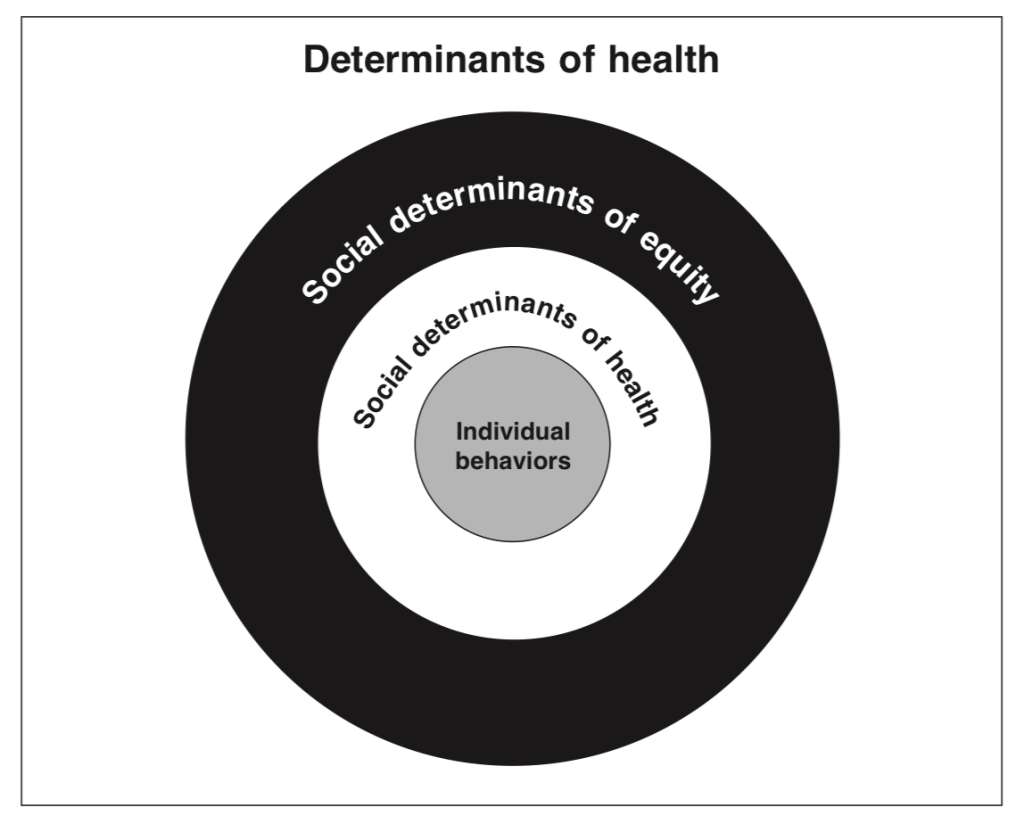
Many factors of health lie outside of individuals’ behaviors and genetic endowments, and instead within their environments. The contexts in which patients (people) reside are collectively known as Social Determinants of Health (SDHs). These contexts are not distributed randomly through probabilistic mechanisms, however; rather, they are shaped by historical injustices and their contemporary, institutionalized structures. These inequitable distributions of SDHs are known as Social Determinants of Equity (SDEs). In order to maximize health outcomes, we must venture beyond traditional conceptions of healthcare and health services, and into the difficult, yet crucial, work of equity.
Levels of Intervention
To address these three levels of health, we must define three levels of intervention: primary prevention, secondary prevention, and tertiary/acute intervention. Let us address these in reverse order by the analogy of a cliff.*

Though there are multiple dangers of walking on a cliffside, the foremost is that of a fall. If someone finds themselves tumbling down a cliffside, they will find waiting for them at the bottom tertiary, or acute, intervention in the form of an ambulance. Tertiary intervention focuses on treating the injuries of those who have fallen off this “cliff of good health.”
If someone had seen the dangers of the cliff, they might have had the foresight to install some sort of safety measure, such as a net at the bottom, to “catch” people who have fallen. This is secondary prevention. It centers on preventing injury among those who have already fallen.
Primary prevention is likely the first solution to come to mind: install a fence at the top of the cliff. Primary prevention aims to lower the risk of falling off the cliff of good health in the first place.
Health Disparities
Even where railings and nets have been installed, and ambulances are waiting at the bottom of the cliff, however, health disparities still do arise. These disparities come from three key aspects: differences in exposure, differences in access to care, and differences in quality of care.
Firstly comes differences in exposure. While some might walk the cliff occasionally, others may live near it and pass by frequently, exposing them more frequently to the dangers of falling.
Among those who do fall, there are still differences in their access to care afterward. Here, it is important to remember that the cliff of good health is three-dimensional: while one might position an ambulance at the bottom, one person might fall in a different, harder-to-access place than another.
Even when the fallen person is picked up by an ambulance, they still face discrepancies in the quality of care they receive: the rotation of EMTs might be different, or they might be taken to a different hospital based on proximity.
Equity and Health on the Cliff
These three aspects of disparities all make one key assumption, however: that all of the structures in place (railings, nets, etc) are present everywhere. The cliff being 3D, and assets being finite, one cannot reasonably assume that the same quantity and quality of resources are being expended everywhere at once. While Social Determinants of Health focus on bringing populations away from the cliff’s edge, Social Determinants of Equity intervene on the processes that result in the inequitable distribution of resources and populations along the cliffside.
Conclusion
Maintaining the health of a population requires intervention beyond the scope of the health sector. The World Health Organization’s Commission on Social Determinants of Health final report, entitled Closing the Gap in a Generation: Health Equity Through Action on the Social Determinants of Health, recognizes this and speaks to an international consensus that health is neither created nor maintained within the health sector alone.
In order to build and perpetuate good health for all populations, we must apply these ideas of SDHs and SDEs both in and outside of the health sector. We must not choose between a railing, a net, or an ambulance, but instead embrace the truth that all three are critical to health. Similarly, we cannot choose between intervening on individual behaviors, SDHs, and SDEs, but must address all three in order to improve health outcomes. Health is a complex product of our individual and social sphere, and, in our attempts to advance health equity, that fact must not be ignored.
*Analogy courtesy of Dr. Camara Jones

 Health Bites
Leave a comment